
Most companies do not have a software shortage. They have a coordination problem.
The CRM knows the customer. The ERP knows the order. The service desk knows the issue. The information exists, but an employee still has to find it, combine it, and update several systems by hand.
People have become the connection between applications.
This is a major productivity opportunity for AI. Instead of replacing the software a company relies on, an AI assistant or agent can sit on top of it—finding information, moving work between systems, and completing routine actions under human supervision.
The software stays. The way work gets done changes.
Extend, don’t replace
Traditional modernization often begins with: Which core system should we replace?
That can mean a large migration budget, operational risk, retraining, and years before the full value arrives. Sometimes replacement is necessary. But it is no longer the only route to better performance.
A better question is: What could our teams achieve if the systems we already own worked together?
An AI agent provides that missing layer. It understands a request, retrieves the right data, uses the right tools, and returns a result a person can review. The application remains the system of record. The agent becomes the system of action.
Value can appear one workflow at a time, without waiting for every old platform to be replaced.
The productivity gain compounds
Consider a customer asking: “Can you confirm the delivery date and tell me whether the installation team is booked?”
An employee may need to check the CRM, ERP, planning tool, and latest email thread. With a connected assistant, the employee asks one question and reviews one answer.
The benefit spreads across the organization:
- Individuals get time back as searching, copying, and reformatting disappear.
- Teams become more consistent because the agent follows the agreed process and flags exceptions.
- The company scales with less friction through faster responses, fewer handover errors, and shorter cycle times.
What the AI layer can do
The best use cases are frequent, repetitive, and spread across several systems.
Answer questions across company data. A manager can ask which customers have not ordered in six months and also have open support issues.
Run cross-system workflows. An agent can collect a request from email, validate the customer, create a service task, update the ERP, and notify the right person.
Strengthen customer support. An assistant can search manuals, account history, product data, and earlier tickets at once.
Clean and move data. During a migration, agents can normalize common records and send only uncertain cases to a person.
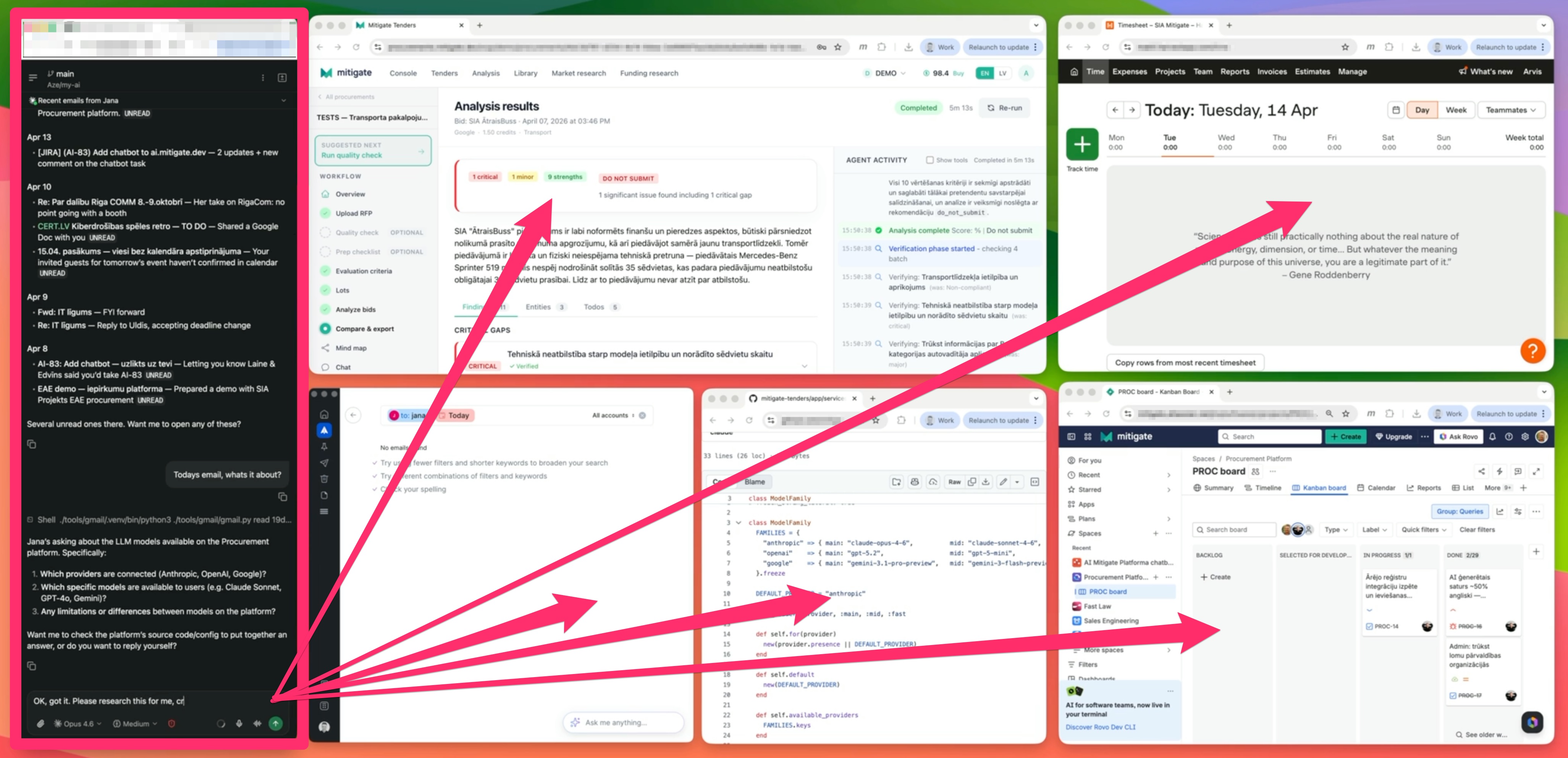
If software has an API, the agent can use it. Standards such as the Model Context Protocol make connections more consistent. If there is no usable API, a controlled computer-use agent can operate the existing interface.
The pattern is simple: AI handles the mechanical work around a decision. People keep control where judgement matters.
How we do it
Install and connect. We install the Mitigate AI Platform as the core AI processing and orchestration layer, then connect it to the CRM, ERP, helpdesk, email, BI, e-commerce, and any other systems the work requires.
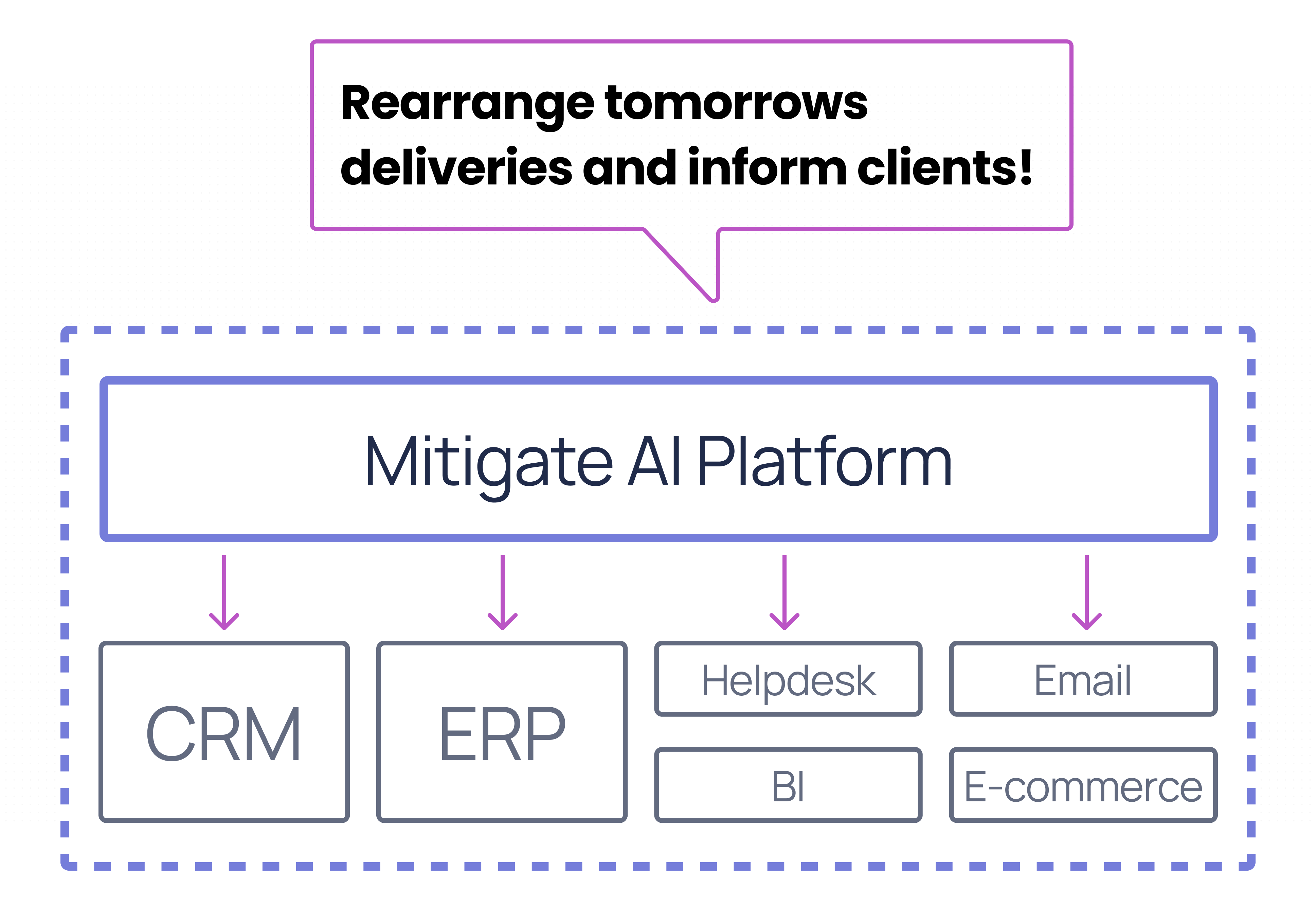
Build the AI+human team. Together with the client, we define as many assistants and agents as the organization needs. Each receives a specialist role, the right knowledge and tools, clear access permissions, and rules for when human approval is required.
Put the team to work. People give requests in plain language. The assistants answer, and the agents perform the necessary work inside the connected systems—returning results for review and involving a person wherever judgement matters.
Start small and prove the return
Choose one frequent, frustrating workflow with clear rules and measurable results.
Start with read-only work. Measure current time, delays, and errors. Require human approval for payments, deletions, contract changes, and other consequential actions. Put authentication, limited permissions, data protection, and audit logs in place from the start.
Once the workflow is faster and reliable, expand to the next one.
This makes the first project a contained investment compared with replacing a core system. It also makes the return visible: hours recovered, cycle time reduced, errors prevented, and customers served faster.
Why Mitigate AI
For 15 years, Mitigate has built and integrated business-critical software. Today, our AI platform adds assistants and agents above the systems companies already use—with the connections, approvals, access controls, and auditability required for real operations.
We understand both sides: the software underneath and the AI layer above it. We can identify a valuable workflow and deliver a controlled solution without asking the organization to start again.
Keep what works. Add intelligence where people lose time. Prove the gain, then scale it.
Want to find the best first workflow in your company? Get in touch. We will map the process, estimate the opportunity, and show you the safest path to an agent-assisted operation.