
We get asked the same question a lot: “What exactly does your AI platform do?” Fair question. There are hundreds of AI tools out there, and most of them sound the same. So let me break down what we actually built and why it’s different from dropping a chatbot widget on your website.
Product one: the AI chatbot
You’ve probably used a chatbot before. Most are frustrating — scripted responses, limited understanding, and the inevitable “I didn’t understand that, let me connect you with an agent.”
Our chatbot is different because it learns from your actual company data. It connects to your documents, knowledge bases, emails, and internal systems. When someone asks a question, it doesn’t guess — it finds the answer in your data and shows where it came from.
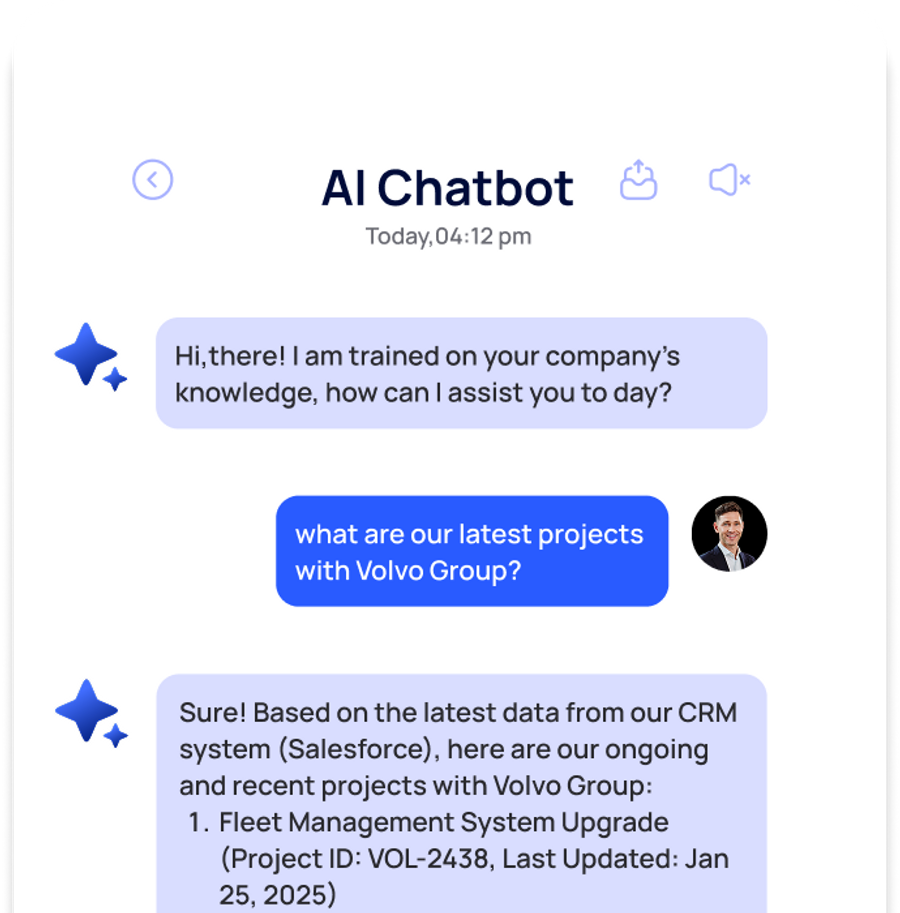
For customers, the chatbot handles support queries, product questions, and account issues around the clock. No wait times, no hold music, no “please describe your issue again.”
For employees, the same chatbot becomes an internal search engine. Need to find a policy document? Check an order status? Look up a project in JIRA? Instead of clicking through five systems, your team asks the chatbot and gets an answer with a source citation in seconds.
According to a Stanford and MIT study, customer support agents using AI tools were 14% more productive on average, with novice workers gaining even more — 35% faster at resolving issues. The difference isn’t just speed. It’s that people stop wasting time on tasks a machine should handle.
You can customize how the chatbot communicates — its tone, its boundaries, even its visual appearance. It adapts to your brand, not the other way around.
Product two: the e-commerce assistant
The second product takes everything the chatbot does and adds a commerce layer. It’s built specifically for online stores where finding the right product is half the battle.
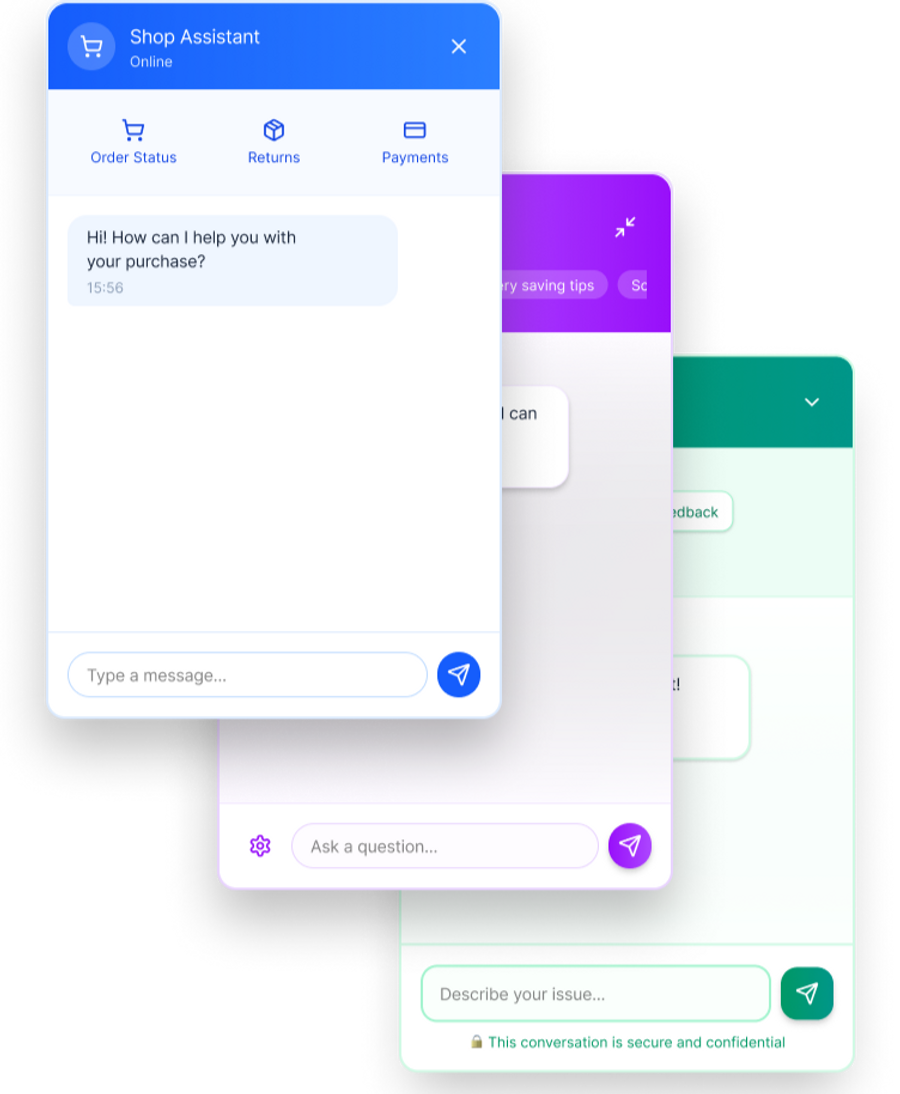
Imagine a customer lands on your site in December, looking for gifts but not sure where to start. Instead of scrolling through categories, they type “affordable, good quality, pink bath bombs” — and the assistant finds matching products instantly, suggests alternatives, and guides them toward checkout.
It works because the assistant knows your entire product catalog — stock levels, pricing, descriptions, customer reviews. It’s like having a knowledgeable shop assistant available 24/7, except it never takes a break and remembers every product you sell.
For businesses with large catalogs, this directly impacts revenue. Customers find what they want faster, cart abandonment drops, and average order value increases through natural, contextual recommendations.
Product three: the AI agent
This is where things get interesting. The chatbot answers questions. The e-commerce assistant helps people buy things. The AI agent does things.
An AI agent connects to your operational tools — JIRA, CRM, email, Trello, Slack — and takes action on your behalf. It doesn’t just tell you that a ticket needs attention. It routes the ticket to the right person, updates the CRM, and drafts a response.
Here’s the key difference from using ChatGPT or Gemini for the same tasks: your data stays on your platform. When you paste confidential client information into a public AI tool, you have no control over where that data goes. With our AI agent, everything runs on your infrastructure. Your data never leaves your servers.
Gartner predicts that by 2029, agentic AI will autonomously resolve 80% of common customer service issues without human intervention. The organizations that deploy agents today will have a three-year head start.
Why one platform matters
The chatbot, e-commerce assistant, and AI agent all run on the same platform — the Mitigate AI Platform. This matters for three reasons:
-
Shared knowledge base. All three products draw from the same company data. You set it up once, and every product benefits.
-
Single security model. One deployment, one set of access controls, one audit log. No patchwork of third-party tools with different security postures.
-
Your infrastructure. Deploy on your servers, your cloud, or ours. Choose your LLM provider — OpenAI, Anthropic, Mistral, or open-source models. Switch anytime without rebuilding anything.
Companies investing in generative AI today are earning $3.70 back for every dollar spent, according to IDC research. The platform approach means you capture that value across customer support, sales, and internal operations — not just one department.
Want to see it in action? Get in touch and we’ll show you how it works with your data.